Contents
Answer Engine Optimization (AEO) is one of the most searched topics right now.. and for good reason. It focuses on making sure your brand or business appears in AI-generated answers and not just on traditional search engine result pages.
Large language models (LLMs), including ChatGPT, Gemini, Claude, DeepSeek, and Perplexity… are changing how search results are shown. Answer Engine Optimization ensures that your content is mentioned when users ask relevant questions. AEO, however, is only one part of the larger shift. When you step back and look at the bigger picture, it’s clear that search is no longer limited to search engines… It’s happening everywhere, be it Google Maps, Yelp, Bing Places for businesses, TikTok, YouTube, Instagram, Facebook, LinkedIn, Pinterest, Google, Yahoo, and all the other platforms.
New research from SEMrush shared insights into the impact of AI search on SEO traffic, and according to them… AI search can be a major revenue and traffic generator by 2027.
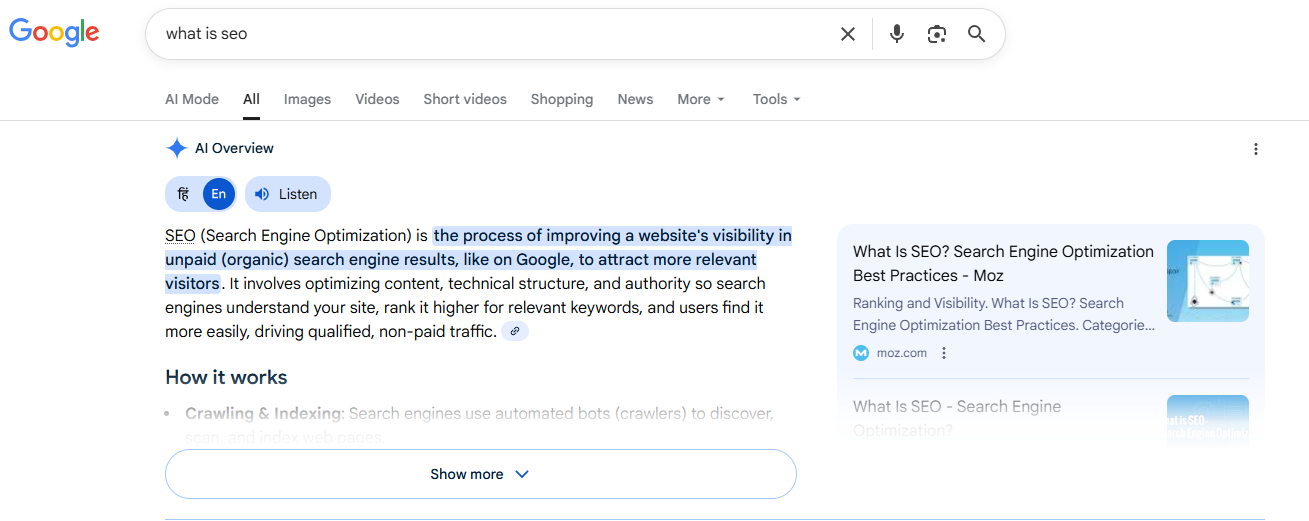
Google has also rolled out AI mode, which offers an experience similar to ChatGPT and has replaced the traditional search pattern. Now, whatever query you will post on Google.. you will have answers from AI.
And our personal research and data show the same, that by 2027-2028, LLMS traffic will overtake traditional traffic. In this guide, I will explain what AEO is, why it differs from SEO, why SEO still matters, and the steps you need to take to optimize the answer engine and drive better, measurable results.
What is AEO and Why It Matters
Answer Engine Optimization (AEO) is the process of optimizing your content so that AI-powered systems can easily understand it, trust it, and use it as a direct answer when someone asks a question. AI-powered systems like Gemini, ChatGPT, Claude, Perplexity, and others.
Traditional SEO was built around rankings… You optimized a page, ranked on page one, and hoped users clicked. But now.. AEO changes that entire flow… because the goal is to be referenced, summarized, or cited inside AI-generated responses.
When someone asks a question today.. the answer may come from-
- Google AI Overviews
- ChatGPT
- Perplexity AI
- Microsoft Copilot
- Voice assistants
- Even social platforms using AI discovery
If your content is not optimized for the AI environment, it might still exist… but it won’t participate in the conversation. And that is why Answer Engine Optimization matters as it shifts your focus from traffic chasing to answer ownership.
Why AEO Matters Now
AEO did not become important overnight… it became important because user behavior changed faster than SEO practices did. Very few people search like this – best CRM software.
Now… more people are searching like this – What is the best CRM software for small businesses with remote teams? And AI engines respond by giving a final answer… not a list of options.
According to insights shared by SEMrush, AI-driven search experiences are expected to become a major traffic and revenue source by 2027. Google’s rollout of AI mode confirms this direction… and the traditional search pattern is already being replaced.
Now… every query you type into Google can trigger an AI-generated response before organic results even load.
This is exactly where AI Search Optimization becomes smarter because visibility is no longer guaranteed by rankings alone; it’s earned through clarity, authority, and structure.
How Answer Engines Actually Work

To optimize for AEO… you need to understand how answer engines think. AI answer engines do not read content like humans… they analyze patterns.
Here is what usually happens behind the scenes-
- The engine interprets the intent behind the question
- It breaks the query into smaller semantic parts
- It scans trusted sources that match the intent
- It looks for clear, well-structured explanations
- It evaluates authority, freshness, and reliability
- It generates a summarized response
- It cites sources when confidence is high
So when people ask… How do AI answer engines like ChatGPT choose their answers? The answer is simple but uncomfortable- they choose content that makes their job easier.
If your page rambles, hides the answer, over-optimizes keywords and lacks credibility…it gets ignored.
And this is where AI Content Optimization matters more than traditional keyword placement.
How AEO and SEO Work Together

AEO does not replace SEO, and anyone saying that is trying to oversimplify the problem.
SEO is still the foundation… without SEO, your pages will not be indexed appropriately. Your domain will not have authority, and most importantly, your content will not be trusted.
AEO sits on top of SEO… think of SEO as getting invited to the table and AEO as being chosen to speak.
Strong SEO improves crawlability, indexing, backlink profiles, and site health.h
Strong AEO improves answer visibility, AI citations, zero-click exposure, and brand recall. The best-performing sites today are doing both..!
And if you want to know how SEO works for a Shopify Store? Read this blog:
Core Principles of AEO
1. Direct Answer Formatting
AI engines prefer content that answers questions quickly and clearly. And this does not mean your content has to be short… it means your answers need to be easy to extract.
Best practices include is..
- Answering the main question within the first few paragraphs
- Using clear subheadings that match search intent
- Writing short, focused paragraphs
- Avoiding unnecessary filler
If a human can skim and understand it in seconds.. AI usually can too.
2. Conversational and Natural Language
AEO works best when content is created by humans or sounds like a human.
AI systems are trained on conversational data. But the content that is written in stiff, overly optimized language performs worse than content that feels natural.
Instead of forcing keywords… write how people actually ask questions… like- What is Answer Engine Optimization? How to optimize content for AI Overviews? What’s the difference between AEO and SEO?
This improves relevance for both humans and AI systems.
3. Structured Data and Schema Markup
Schema markup helps AI understand context… not just content.
If you want your content cited, structured data matters. Important schema markup types for answer engines include. FAQ schema, HowTo schema, Article schema, Author schema, and Organization schema
Many people ask: How can they use the FAQ schema to get cited in AI Overviews?
The answer is not to fake FAQs. It’s to create genuine question and answer sections that solve real problems, then mark them up correctly. AI systems are surprisingly good at detecting low-quality schema usage.
4. E-E-A-T Principles
The most important for SEO and AEO. Experience, Expertise, Authoritativeness, and Trustworthiness play a major role in AI SEO.
AI engines are cautious, and they do not want to surface misleading or low-quality information.
When you strengthen E-E-A-T by sharing first-hand experience, showing real expertise, using credible references, displaying clear authorship, and keeping content updated.
This is especially important for topics that influence decisions.
AEO Content Strategy

1. Creating Answer-Worthy Content
Answer-worthy content is written with intent clarity. Before publishing, ask… what question does this page answer? Is the answer obvious? Can this answer stand alone if quoted?
If the content cannot survive outside its page… AI probably won’t use it.
2. Content Formats That Perform Well
Some formats naturally work better for Answer Engine Optimization.
- FAQs
- Step-by-step guides
- Explainers
- Comparisons
- Definitions
These formats reduce ambiguity and improve extractability.
3. The Importance of Featured Snippets
Featured snippets are still one of the strongest signals for AEO. If Google already trusts your content enough to feature it, AI Overviews are more likely to reference it.
Optimizing for snippets will directly or indirectly strengthen AEO performance.
Technical AEO Optimization

1. Site Architecture and Navigation
AI crawlers prefer user-friendly UI/UX and clean and logical site structures. Good architecture includes clear internal linking, logical categories, shallow click depth, and searchable and clutter-free URLs.
If AI struggles to navigate your site… it struggles to trust it.
2. Page Speed and Mobile Optimization
Speed matters more than ever because slow pages are often skipped, especially for AI-driven summaries where speed and usability are critical.
Mobile-first optimization is no longer optional.
3. Content Freshness
AI engines prefer updated content like refreshing old articles, updating statistics, and adding recent examples to increase your chances of being cited.
Outdated content slowly and eventually loses AI visibility as well as SEO visibility.
4. Keyword Research for AEO
AEO keyword research focuses less on volume and more on intent. Yes.. for AEO and SEO, intent is important, and the key areas include-
- Long-tail question keywords
- Conversational queries
- Semantic variations
- Context-based optimization
This is where traditional keywords are used to capture real user behavior.
AI and Automation have become a strong part of Digital Marketing. Here are the Digital Marketing trends you should not miss –
Building Authority and Credibility for AEO
Authority is one of the most underestimated parts of Answer Engine Optimization. Many sites focus heavily on formatting and schema but ignore the trust layer. AI systems look for correct answers as well as safe answers.
1. Creating Citation-Worthy Content
For AI engines… not all content is worth citing. Citation-worthy content usually has-
- Clear explanations without exaggeration
- Original insights or practical observations
- Logical flow that does not confuse context
- References to credible data or sources
If your content sounds like it was written just to rank… it rarely gets cited. AI engines prefer content that feels written to explain and not to manipulate.
2. Brand Authority Signals
Brand authority plays a bigger role in AEO than most people realize. AI systems learn from patterns across the web…. If your brand shows up consistently in trusted environments, it surely builds confidence.
But what are the brand authority signals?
- Mentions on reputable blogs or publications
- Active presence on platforms like LinkedIn or YouTube
- Podcast appearances or interviews
- Consistent brand references across the web
Even without backlinks, brand mentions help AI engines recognize your business as a legitimate entity.
3. Author Authority
Who writes the content matters… AI engines pay close attention to authorship, especially for informational and decision-based queries.
Strong author authority includes
- Clear author name and bio
- Relevant experience or credentials
- LinkedIn or professional profile links
- Consistent topic expertise across content
This directly supports E-E-A-T and increases the likelihood of AI citing your content over anonymous pages.
AEO for Different AI Platforms
Not all AI platforms work the same way, and understanding how each one prioritizes information helps you optimize smarter.
1. Google AI Overviews (SGE)
Google AI Overviews heavily on structured answers, strong SEO fundamentals, clear E-E-A-T signals, and featured snippet eligibility.
Content that already performs well organically and answers questions cleanly has a higher chance of being included.
Google still values traditional SEO signals, so AEO and SEO balance is important here.
2. ChatGPT and OpenAI
ChatGPT pulls information from a mix of licensed data, publicly available content and trusted sources. It prefers-
- Clear explanations
- Neutral, factual tone
- Well-structured content
- Strong domain authority
And the pages that are frequently referenced or cited across the web tend to perform better in ChatGPT-generated responses.
3. Perplexity AI
Perplexity is one of the most transparent AI answer engines. It actively shows citations, which makes optimization clearer. It provides –
- Direct answers
- Clear headings
- Fact-based content
- Reliable sources
If your content is structured and credible… Perplexity is more likely to link to it directly.
4. Microsoft Copilot
Microsoft Copilot shows Bing search data with AI summaries. This means-
- Bing SEO still matters
- Structured data improves understanding
- Content clarity and authority influence inclusion
Optimizing for Copilot often feels like optimizing for Bing SEO with an AEO mindset layered on top.
How to Measure AEO Success

Measuring Answer Engine Optimization is not as easy as traditional SEO because there is no single metric that tells the full story.
Instead… you look at a combination of signals.
1. Brand Mentions
Are you seeing your brand mentioned in AI-generated answers? This is one of the strongest indicators that AEO is working.
Manual checks across platforms like ChatGPT and Perplexity can reveal this over time.
2. Zero-Click Visibility
Even if traffic does not increase immediately… visibility might.
If users see your brand inside AI Overviews or summaries, awareness and trust grow silently. This often leads to indirect conversions later.
3. AI Citation Rate
Some platforms… especially Perplexity, make citations visible.
Tracking how often your content gets cited gives you a direct measure of AEO performance.
4. Authority Score Growth
As AEO improves… You will often notice-
- Better branded search
- Increased mentions
- Higher trust signals
These changes may not show up instantly in rankings, but they compound over time.
Tools for AEO Monitoring
There is no dedicated AEO tool yet… but several tools help support the process.
- Brand Monitoring Tools like Brand24 and Mention
- Manual Citation Tracking
- Traditional SEO Tools like Ahrefs and SEMrush
- Schema Validation Tools
- Answer Engine Testing
Common AEO Mistakes to Avoid
Even well-optimized sites make these mistakes.
- Over-Optimization – Forcing keywords or schema can make content unnatural and reduce trust.
- Neglecting Traditional SEO – AEO without SEO is unstable…. You need both.
- Lack of Originality – Generic content rarely gets cited… AI prefers unique insights.
- Ignoring Content Updates – Outdated content loses relevance quickly in AI systems.
- Poor Source Attribution – If your content lacks references or credibility, AI engines hesitate to use it.
The Future of Answer Engine Optimization
AEO is not a short-term tactic…. It’s a long-term shift.
As AI becomes the first point of interaction for search, brands that adapt early will control visibility. Those who rely only on rankings will slowly lose presence.
In the future… rankings, relevance, traffic, authority, and being the answer will matter more than being on page one.
Answer Engine Optimization is not about gaming AI… It’s about helping it do its job better.
And the brands that understand that now will be the ones AI trusts tomorrow.
If your eCommerce brand needs AEO and SEO both, then connect with our experts today. Because the future is not waiting, it’s happening now!
Connect with Our Shopify Experts Today!
Schedule a Meeting

Amit Porwal
CEO and FounderAmit Porwal is the CEO and Founder of Expert Village Media and Wiser AI . He’s passionate about e-commerce, and loves helping Shopify store owners boost sales with upselling, cross-selling, digital marketing, & personalized shopping experiences. With years of experience in e-commerce web development Amit believes in building simple and effective online store that actually make a difference. He is always excited to talk about the power of personalization and how he can make e-commerce smarter and more customer-friendly with the help of AI.