SEO vs Paid Ads for Shopify: What Works Better in 2026?
Contents
You built the store. You got the products lined up. The branding looks clean, the checkout is smooth and you have even tested the mobile experience yourself.
And then…
No traffic. No sales. Just you hitting refresh on your Shopify analytics dashboard wondering what you are missing.
This is where most Shopify store owners hit that first wall and it almost always leads to the same question- Should I invest in SEO or should I just run paid ads?
It’s one of the most common debates in ecommerce marketing right now and there is no single right answer. The right choice depends heavily on where your store is today, what your goals look like six months from now and how much runway you actually have in your budget.
This blog will walk you through both channels so that you can make the right decision. Our experts have worked with Shopify stores across different niches, budgets and growth stages and what we have seen is that the stores doing best in 2026 are not picking one over the other. They are being smart about how they use both. Read on to understand it better!
What is Shopify SEO?
Shopify SEO is the process of improving your store so it can appear in organic search results when shoppers look for products, categories or answers related to what you sell.
For example… if someone searches for “handmade leather tote bag,” “non-toxic candles” or “best protein powder for women,” SEO helps your product pages, collection pages and blog posts related to the search query show up in those search results.
Good Shopify SEO is not limited to adding keywords to a page, it includes your site structure, product descriptions, collection page content page speed, internal links, image optimization, reviews, schema markup and the overall shopping experience.
Shopify SEO helps your store become easier for both Google and customers to understand.
When it is done well… SEO can bring visitors who are already looking for something you sell. That is what makes organic traffic valuable. And these shoppers are not randomly browsing, they have intent!
What Are Paid Ads for Shopify?
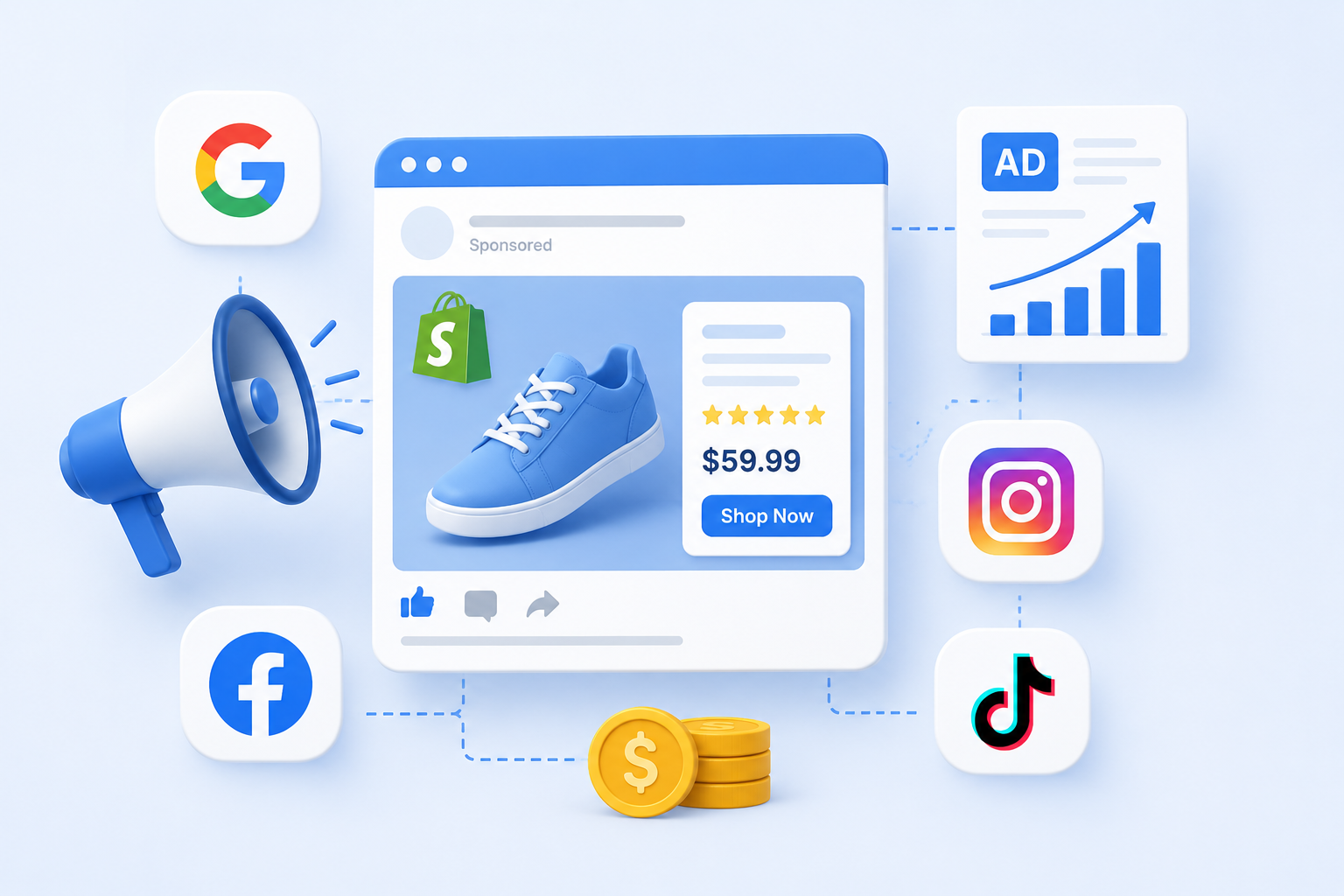
Paid ads are campaigns where you pay platforms to send traffic to your Shopify store. These platforms can include Google, Facebook, Instagram, TikTok, Pinterest, YouTube or Microsoft Ads.
For ecommerce stores … paid ads usually include Google Shopping ads, search ads, Performance Max campaigns, Facebook and Instagram ads, retargeting ads and product-focused social campaigns.
The biggest advantage of paid ads is speed. You do not have to wait months for visibility. Once your campaign is approved and active, your products can start appearing in front of potential customers.
But there is a catch… paid ads keep working only as long as you keep paying. If your budget stops, your traffic usually stops too.
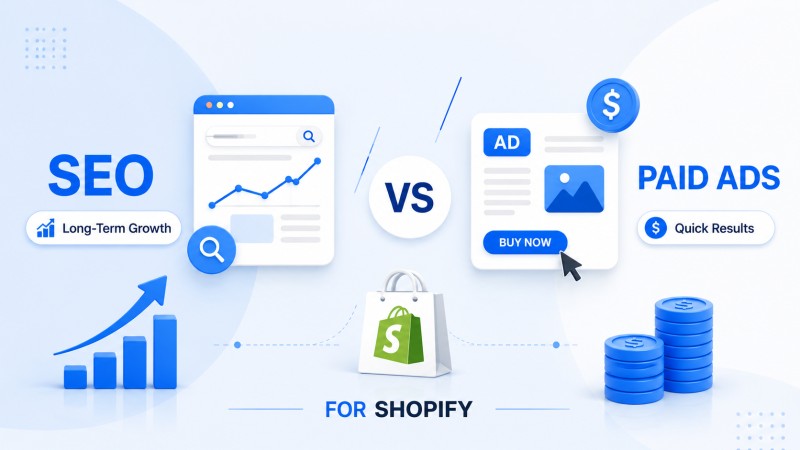
That is the main difference between Shopify SEO and paid ads. SEO builds visibility over time and Paid ads gives you quick traffic and leads.
Shopify SEO vs Paid Ads: The Main Difference
The simplest way to understand Shopify SEO vs Paid ads is this- SEO is a long-term growth channel, while paid ads are a short-term traffic and testing channel.
- SEO (Search Engine Optimization) takes time because search engines need to crawl, understand and trust your pages. You may not see strong results in the first few weeks or may be months. But once your pages begin ranking, they can continue bringing traffic without you paying for every click.
- Paid ads work much faster. You can launch a campaign and start getting traffic within a week. This makes ads useful when you want to test a product, promote a sale, launch a new collection or retarget people who already visited your store.
The downside is that paid ads can become expensive if your product pages, pricing, offer or tracking are not strong. You can spend a lot of money and still not get profitable sales.
SEO is slower… but it builds assets. Paid ads are faster but they require continuous budget and that is why both channels have a place in ecommerce.
Is SEO Worth It for Shopify?
Yes… SEO is worth it for Shopify if you want long-term growth.
Many Shopify store owners ignore SEO in the beginning because paid ads feel more exciting. We get it that ads give quick data and SEO feels slower. But over time… relying only on ads can become costly.
Ad costs can rise. Campaign performance can drop. A platform update can change results overnight. If all your traffic comes from paid campaigns… your store becomes dependent on rented traffic.
SEO gives you another source of visitors.
- A well-optimized collection page can rank for category searches.
- A helpful blog post can bring shoppers who are still researching.
- A strong product page can appear when someone searches for a specific item.
These organic visits can support your store month after month.
SEO also improves the quality of your website. When you work on SEO, you naturally improve product descriptions, navigation, internal links, page speed, FAQs, images and customer trust signals. These improvements help both organic visitors and paid visitors.
So yes… SEO is worth it for Shopify. It may not give instant results but it can become one of your most valuable growth channels.
Does SEO Work for Shopify Stores?
SEO does work for Shopify stores but only when the strategy is built around ecommerce search intent.
The mistake many brands make is treating SEO like basic blogging. They publish a few long articles, add some keywords and wait. When nothing happens… they assume SEO does not work.
That is not a real Shopify SEO strategy.
For ecommerce.. SEO needs to focus on product pages, collection pages and helpful content that supports buying decisions. Collection pages are especially important because people usually search by category before they search by product name.
For example… a customer may search “linen bedding,” “vegan skincare,” “ceramic dinnerware,” or “small space office desk.” These searches usually match collection pages better than individual blog posts.
Product pages also need more than a short description. They should explain what the product is, who it is for, what makes it different, how it is used and why someone should trust it. Reviews, clear images, shipping details, size guides and FAQs can all help improve both SEO and conversions.
Blog content also has a role but it should answer customer questions. A skincare store can write about routines, ingredients, skin types and product comparisons. A fitness store can create guides around workouts, gear, sizing and use cases. A home decor store can write about styling, materials, room ideas and buying tips.
SEO works when your content helps shoppers move closer to a decision.
How Long Does Shopify SEO Take to Work?
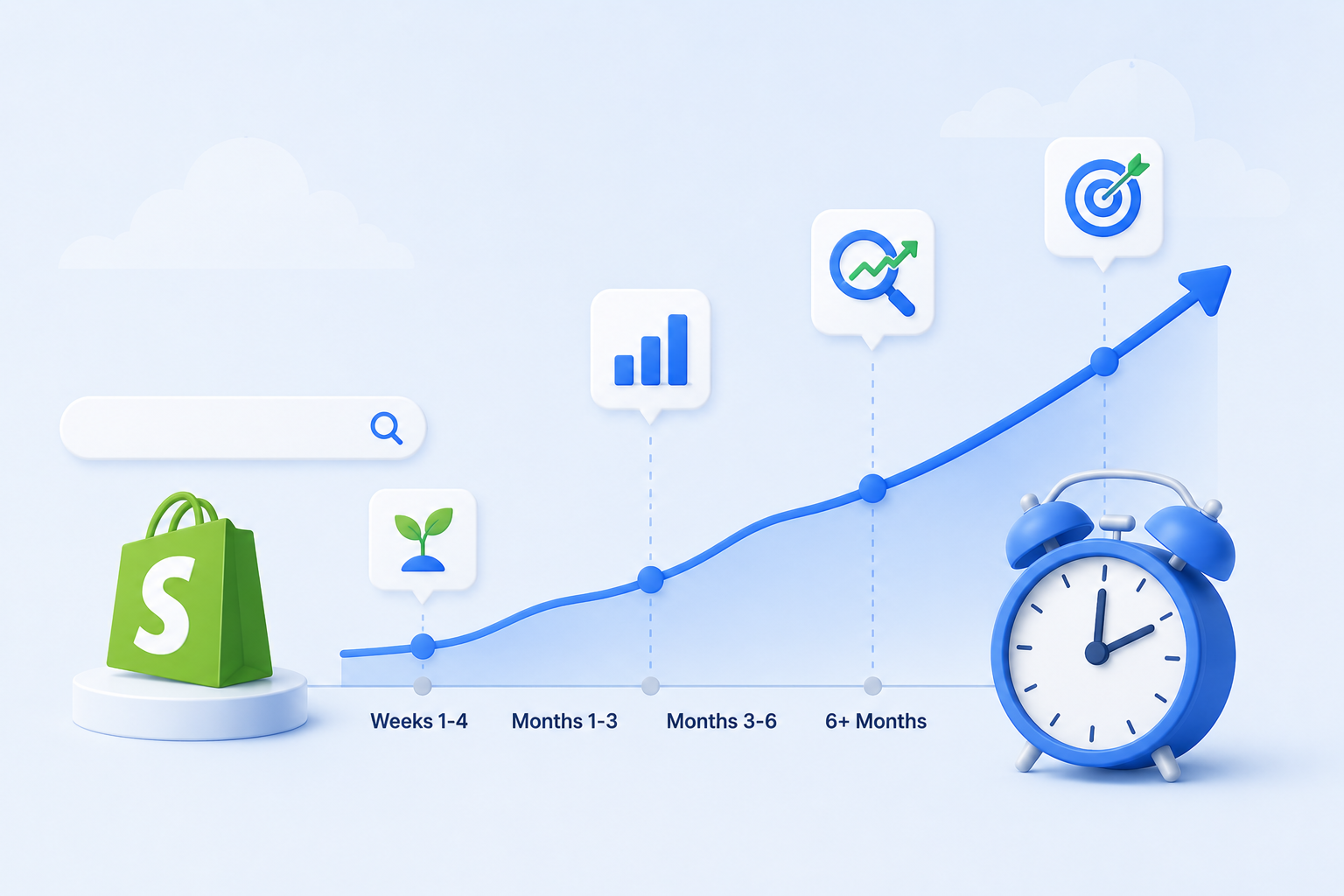
Shopify SEO usually takes around 3 to 6 months to show early progress and 6 to 12 months to show stronger results. The exact timeline depends on your niche, competition, site age, product demand and how well your store is optimized.
Here is a month-wise breakdown.
Month 1- Setup and Optimization
The first month is mostly about fixing the foundation. This includes improving product titles, meta descriptions, collection pages, product descriptions, image alt text, internal links, page speed, and mobile experience.
You should also make sure Google Search Console and Analytics are set up properly. At this stage… You may not see a big traffic increase. The goal is to make your Shopify store easier for Google and shoppers to understand.
Months 2 to 3- Early Search Signals
By the 2nd or 3rd month, you may start seeing small signs of progress. Your pages will get more impressions in Google Search Console and some keywords may begin moving up.
This is also the time to publish helpful content around customer questions, buying guides, product comparisons and collection-related topics. You may not see strong sales yet… but your store is starting to build search visibility.
Months 4 to 6- First Traffic Growth
Between months 4th and 6th, SEO usually becomes more noticeable. Some collection pages, product pages, or blog posts may start getting organic clicks.
You may also begin to see a few conversions from organic traffic. Results can still be uneven… but this is when you can identify which pages are gaining traction and improve them further.
Want to know what works and what does not? Check out our complete Shopify SEO checklist.
Months 6 to 12- Stronger Results
After 6 months, Shopify SEO can start bringing better-quality traffic. Your store may rank for more long-tail keywords, and optimized pages may start supporting sales more consistently.
This is also when SEO begins to compound. A strong collection page or helpful blog post can keep bringing visitors without paying for every click.
SEO is not slow because it does not work. It is slow because trust takes time. Paid ads stop when the budget stops, but a well-optimized SEO page can keep working long after it is published.
Need Help with Shopify SEO? Hire a Shopify SEO Expert Today!
When Should You Use Paid Ads vs SEO?
You should use paid ads vs SEO based on your store’s current goal… not just because one is fast and the other is slow. That is where many Shopify store owners make the wrong call.
- Paid ads can bring visibility faster, but they do not guarantee sales. Ads work by placing your product in front of people through platforms like Google, Meta, TikTok, Pinterest, or YouTube. The platform uses your campaign goal, budget, product feed, audience signals, creative, tracking data, and bidding system to decide where and when to show your ads.
That means paid ads work best when your Shopify store is already ready for traffic. Your product pages should be clear, your pricing should make sense, your checkout should be smooth and your conversion tracking should be set up properly. Without that… ads may bring visitors, but not enough buyers.
Paid ads are usually useful when you want to test a product, promote a sale, retarget visitors, launch a new collection, or push a product that already has proven demand. They can also help you understand which product images, offers, messages, and audiences respond best.
- SEO for Shopify works differently. Shopify SEO helps your store appear in organic search when people are looking for products, comparisons, reviews, or answers. It does not depend on daily ad spend, but it needs time, consistency, and strong page quality.
SEO is a better fit when your products or categories have search demand. For example, if people search for “organic cotton baby clothes,” “ergonomic office chair,” or “non-toxic cookware,” SEO can help your collection pages, product pages, and blog content show up for those searches.
Here is an easy way to decide-
- Use paid ads when you need controlled visibility, testing, retargeting, or promotion.
- Use SEO when you want long-term organic traffic and a stronger search presence.
- Use both when you want short-term traffic and long-term growth, working together.
The best answer for SEO vs paid ads for Shopify is not always one or the other. Paid ads can help you learn faster. SEO can help you build a stronger traffic base over time.
Shopify SEO vs Facebook Ads
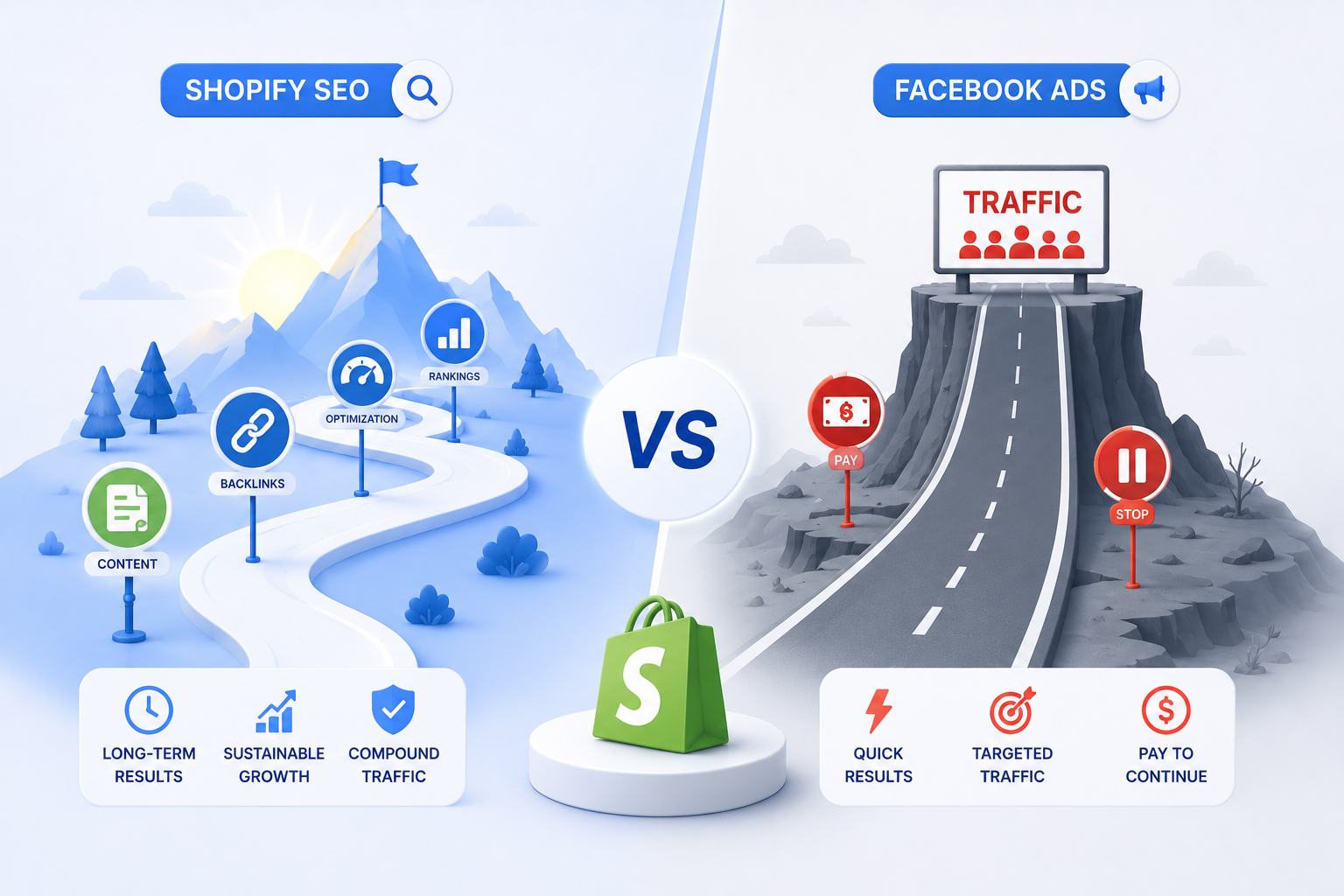
The comparison between Shopify SEO vs Facebook Ads is actually a comparison between search intent and social discovery.
With Shopify SEO, people usually come from search engines because they are looking for something. They may be comparing products, checking reviews, looking for a solution or searching for a specific type of item. Your job is to make sure your store has useful pages that match those searches.
Facebook ads work in a different way. Most people do not open Facebook or Instagram to search for a product. They are scrolling, watching videos, browsing updates or interacting with content. Your ad appears in that experience and tries to get their attention.
That does not mean Facebook ads only interrupt people. A good Facebook ad can introduce a product, explain a problem, show a benefit or remind someone about an item they viewed earlier. Meta can also use catalog ads to show relevant products to people based on their behavior, such as viewing a product or adding something to the cart.
So, Facebook ads can support both discovery and retargeting.
For Shopify stores, Facebook ads may work well when the product has a strong visual angle, a clear use case or a simple problem-solution story. But performance depends heavily on creative, offer, landing page quality, audience signals and tracking.
SEO is stronger when buyers are already searching. Facebook ads are stronger when you need to create awareness, test creative angles or bring back people who already visited your store.
For example, if someone searches “Affordable knitted tops for women,” SEO can help your product or collection page appear during active research. But if someone sees a short video showing how you can style a knitted top in different ways, a Facebook ad may create interest before they ever search.
That is why Shopify SEO vs Facebook Ads should not be treated as a direct replacement. SEO captures existing demand. Facebook ads can create demand, test demand, and recover lost visitors through retargeting.
SEO vs PPC for Ecommerce
The debate around SEO vs PPC for eCommerce is common because both channels can bring traffic but they work in very different ways.
PPC or pay-per-click advertising means you usually pay when someone clicks your ad. In ecommerce… PPC can include Google Search ads, Shopping ads, Performance Max campaigns, Microsoft Ads and some paid social campaigns, depending on the platform setup.
Google Ads does not simply show the highest bidder every time. Ad visibility can depend on factors like bid, ad quality, landing page experience, search context, ad assets and expected performance. This is important because a better landing page and more relevant ad can help your campaign perform better.
For Shopify stores, PPC can be useful when people are already searching with buying intent. Someone searching “buy waterproof hiking boots” or “best running belt for marathon” may be closer to purchase than someone casually scrolling social media.
SEO also captures search intent but without paying for each click. The tradeoff is that SEO takes longer to build. You need optimized collection pages, useful product pages, technical SEO, internal links, helpful content and trust signals.
Here is the comparison-
| PPC |
SEO |
| PPC can give faster visibility but costs continue as long as you want traffic. | SEO takes longer but strong pages can keep bringing traffic over time. |
| PPC gives faster testing data. | SEO gives long-term content and page value. |
| PPC depends on budget, competition, tracking, and conversion rate. | SEO depends on relevance, authority, content quality, and technical health. |
PPC and SEO work best together. PPC can show which products and messages attract clicks. SEO can use those learnings to improve product pages, collection copy, blog content and FAQs.
Shopify SEO Cost vs Paid Ads
When comparing Shopify SEO cost vs paid ads, the main difference is how the cost works.
Paid ads require ongoing media spend. You may also need a budget for creatives, campaign management, product feed setup, and landing page improvements. If your ad spend stops, the traffic usually stops too.
SEO has a different cost structure. You invest in strategy, page optimization, content, technical fixes, and internal linking. Results take longer, but optimized pages can continue bringing traffic over time.
Paid ads buy traffic opportunities. SEO builds traffic assets.
That does not mean SEO is free. It needs consistent work. But over time, SEO can help reduce dependence on paid traffic, especially for Shopify stores with strong product and collection page optimization.
For many Shopify stores, the better approach is not to choose only one. Use paid ads carefully where you can measure performance and invest in SEO so your store does not depend only on paid traffic.
Shopify SEO ROI vs Paid Ads
Shopify SEO ROI vs paid ads should be measured differently.
Paid ads can show results faster. You can track spend, clicks, conversions, cost per purchase and return on ad spend. But you also need to check actual profit after product cost, shipping, discounts, returns and fees.
SEO ROI takes longer to show. In the beginning, you may track impressions, keyword growth, clicks and page performance. Later… you can measure organic revenue, assisted conversions, email signups and non-branded search traffic.
Paid ads give faster data. SEO gives longer-term visibility.
Here is the difference-
|
SEO ROI |
Paid Ad ROI |
| SEO can deliver longer-term visibility. | Paid ads can deliver quicker data. |
| SEO helps you build trust and organic discovery. | Paid ads help you test offers and audiences. |
| SEO needs ongoing improvement. | Paid ads need ongoing spend. |
The best Shopify stores often use both. Paid ads help drive traffic and sales now. SEO helps improve long-term profitability by reducing full dependence on paid clicks.
If rising ad costs are making growth harder, working with Shopify SEO experts can help you build organic traffic that supports your store beyond paid campaigns.
Should I Use SEO and Paid Ads Both for My Shopify Store?
Yes, most Shopify stores should use SEO and paid ads both, but not always with the same budget.
For a new store, build the SEO foundation first and use paid ads carefully for testing. For a store with some sales, ads can help scale what is working while SEO builds long-term traffic. For an established store… both channels should work together.
A smart combination should include-
- SEO for product pages, collection pages, and blogs.
- Paid ads for testing, retargeting, and promotions.
- Ad data to improve SEO messaging.
- SEO content to support paid traffic conversions.
Using both gives your Shopify store a stronger and safer traffic mix.
Best Way to Get Traffic to a Shopify Store
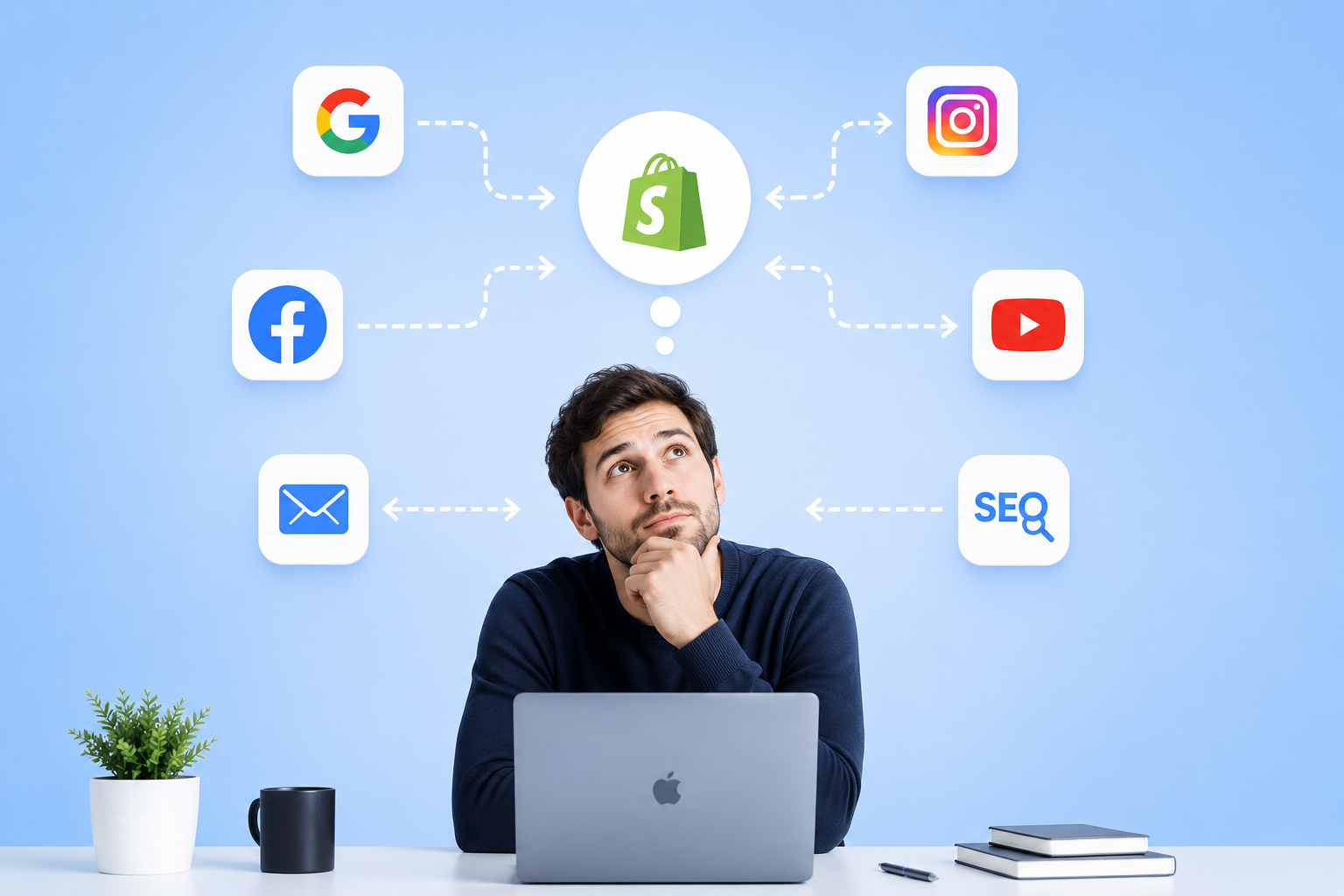 The best way to get traffic to a Shopify store is to choose channels based on how your customers shop. Not every traffic source works the same way. Some shoppers search when they already know what they want. Some discover products through social media. Others need more information before they feel ready to buy.
That is why a strong Shopify traffic strategy should include the right amount of SEO, paid ads, content, email and retargeting.
- Start With Search Intent
If people are already searching for your products, SEO and Google Ads can work well. For example… if someone searches for “organic cotton baby clothes” or “comfortable office chair,” they already have buying intent.
In this case, your product pages, collection pages, and blog content should be optimized to answer what they are looking for. This is where Shopify SEO can help your store appear in front of shoppers who are already interested.
- Use Paid Ads for Discovery and Retargeting
If your product needs to be seen before people search for it, paid ads can help. Platforms like Facebook, Instagram, TikTok, Pinterest and YouTube are useful.
Paid ads can also bring back visitors who did not buy the first time. For example, someone may view a product, leave the store and later see a retargeting ad that reminds them to complete the purchase.
- Use Content When Buyers Need Education
Some products need explanation before a customer buys. This is common for skincare, supplements, tech products, home products, fitness items and high-ticket products.
In these cases… blogs, buying guides, comparison pages, and FAQs can help shoppers understand the product better. This also supports SEO because your store can rank for helpful, question-based searches.
- Make Sure Your Store Is Ready for Traffic
Before sending more visitors to your Shopify store, make sure the store can convert them. More traffic will not help much if the website is confusing or incomplete.
Your store should clearly explain-
- What the product is
- Who it is for
- Why it is worth buying
- What makes your brand trustworthy
- How shipping, returns, sizing and support work
Product pages should include clear descriptions, strong images, reviews, FAQs and visible calls to action. The strongest way to get traffic to a Shopify store is to bring the right people to a store that is ready to turn them into customers.
How to Grow a Shopify Store Without Ads
If you want to know how to grow Shopify store without ads, SEO is one of the best long-term options.
You can also use email marketing, organic social media, influencer partnerships, affiliate marketing, referrals, YouTube, Pinterest and brand collaborations. But SEO is especially powerful because it helps you reach shoppers who are already searching.
Growing without ads takes more patience. You need useful content, optimized pages, consistent publishing and strong internal links. You also need to understand what your customers search before they buy.
For example… a pet brand can create content around pet care, product comparisons, breed-specific needs and safety questions. A home decor brand can write about materials, styling ideas, room guides and seasonal trends. A fashion brand can build content around outfit ideas, fabric guides, sizing and occasion-based collections.
The goal is not to publish content for the sake of content. The goal is to help customers make better buying decisions. That is what makes SEO work.
Not sure how to balance SEO and paid ads for your specific store? The answer depends on your niche, your margins, your current traffic and your growth goals. Hire a Shopify expert to get the right solution!
SEO vs Paid Ads for Shopify: Which One to Choose?
So, what works better: SEO or paid ads?
Paid ads work better when you need traffic quickly. They are useful for launches, testing, promotions, retargeting and scaling products that already convert.
SEO works better when you want long-term traffic, stronger organic visibility, better trust and lower dependence on paid clicks.
For most Shopify stores, the best answer is both.
Use paid ads for speed. Use SEO for stability. Use ad data to understand what customers respond to. Use SEO to turn that insight into long-term traffic. Use paid retargeting to bring visitors back. Use organic content to build trust before and after the sale.
A Shopify store that depends only on ads can become expensive to run. A store that depends only on SEO may grow too slowly in the beginning. But a store that uses both with a clear strategy has a better chance of building steady, profitable growth.
If you are trying to decide where to invest first, start with your current problem.
If you do not have traffic, use paid ads carefully while building your SEO foundation.
If you have traffic but poor sales, fix your product pages and conversion issues first.
If your ad costs are too high, invest more in SEO.
If your SEO is growing but sales are slow, use paid retargeting and better offers.
The goal is not just to get more visitors. The goal is to get the right visitors and turn them into customers.
That is where a balanced Shopify marketing strategy wins.

Amit Porwal
CEO and FounderAmit Porwal is the CEO and Founder of Expert Village Media and Wiser AI . He’s passionate about e-commerce, and loves helping Shopify store owners boost sales with upselling, cross-selling, digital marketing, & personalized shopping experiences. With years of experience in e-commerce web development Amit believes in building simple and effective online store that actually make a difference. He is always excited to talk about the power of personalization and how he can make e-commerce smarter and more customer-friendly with the help of AI.
 US Office
 INDIA Office
 UK Office