

How to Start an Online Clothing Business with Shopify: Complete Guide
Contents
Clothing is one of the few things every single person on earth buys, and keeps buying. Styles change, seasons turn, wardrobes get replaced, and people shop for how they want to feel, not just what they need to wear. That constant demand is exactly why online clothing brands keep launching and growing, even in years when other retail categories slow down.
The numbers back this up. According to Grand View Research, the global apparel market was valued at around USD 1.8 trillion in 2025 and is expected to reach roughly USD 1.9 trillion in 2026. More importantly for anyone selling online, apparel bought through online channels is projected to grow faster than any other sales channel, at a compound annual rate of about 6.2% through 2033. In the United States alone, fashion eCommerce revenue is on track to move well past USD 145 billion and climb toward USD 219 billion by the end of the decade.
Here is the part that should encourage you. This market is no longer controlled only by big fashion houses and department stores. Independent labels, small design studios, print on demand sellers, and niche brands are winning real customers online, partly because more than half of internet users now buy clothing online and roughly 80% of visits to fashion stores happen on a phone. The internet lets you reach the exact person your clothing is made for, no matter how specific your style or audience is.
But there is a catch. Jumping in without a plan is where most new clothing sellers stumble. Picking the wrong business model, skipping brand work, or building product pages that do not answer buying questions costs time and money that could have been saved with a clearer start.
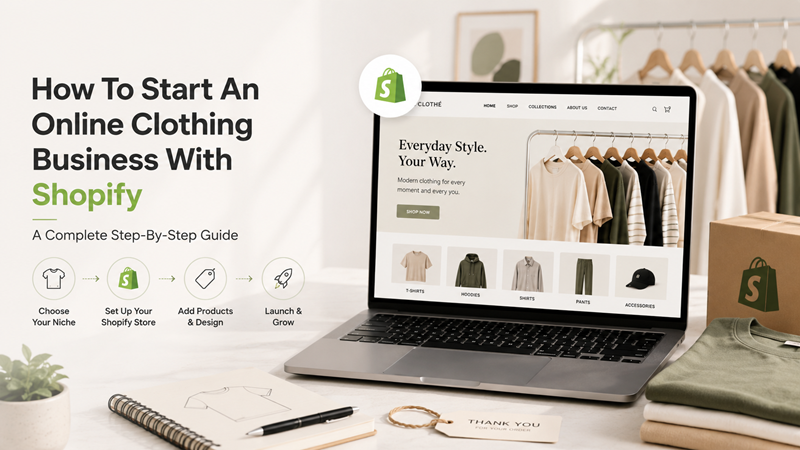
That is what this guide is for. Whether you are starting completely fresh or you already sell at markets and want a proper online home, this walkthrough covers how to start an online clothing business on Shopify, one of the most trusted eCommerce platforms in the world.
Before You Start, Plan Your Clothing Business
A lot of new sellers open a store builder and start picking themes on day one. It feels productive, but it usually creates confusion later.
Before you choose a theme or upload a single product, you need to answer a few basic business questions. Your answers will shape your branding, your pricing, your product photography, your sizing approach, your shipping policy, and your marketing.
1. What type of clothing will you sell?
The clothing market is huge. Trying to sell everything to everyone makes a store feel generic and forgettable. A focused niche helps customers understand your brand in seconds and helps you compete against much larger stores.
Some clothing niches worth considering:
- Everyday basics and essentials
- Streetwear and graphic apparel
- Activewear and athleisure
- Sustainable or organic clothing
- Plus-size and inclusive sizing
- Modest fashion
- Loungewear and sleepwear
- Workwear and office clothing
- Kids and baby clothing
- Vintage and thrifted fashion
- Custom and print on demand apparel
- Occasion wear and event dressing
- Maternity clothing
- Luxury and premium fashion
You can niche down further by style, audience, price point, or values. For example, sustainable everyday basics for working women is far clearer than a generic women’s clothing store.
2. Who is your ideal customer?
Your audience shapes every decision you make. A college student buying a USD 25 graphic tee has very different expectations from a professional buying a USD 180 tailored blazer.
Think through:
- Age group
- Gender or style preference
- Budget and price sensitivity
- Lifestyle and daily routine
- Body type and fit priorities
- Shopping habits
- Which social platforms they use most
- What usually stops them from buying online
If your audience shops mostly on Instagram and buys on impulse, your store should feel fast, visual, and mobile first, with easy checkout. If your audience buys premium pieces, your product pages need fabric details, fit guidance, care instructions, and strong trust signals. The clearer your customer picture, the easier every later choice becomes.
3. What makes your clothing brand different?
People rarely buy clothing purely for fabric and stitching. They buy identity, confidence, belonging, comfort, and self-expression. Your difference is the reason someone picks you over the hundreds of other options a search away.
Your edge could be:
- A distinct design signature
- Genuinely sustainable materials
- Better fit or inclusive sizing
- Affordable quality
- A strong cultural or community angle
- Small-batch, limited drops
- Premium fabrics
- Thoughtful packaging
- A story customers want to be part of
If you cannot explain in one sentence why someone should buy from you instead of a bigger brand, your customers will struggle to see it too.
Choose Your Clothing Business Model First
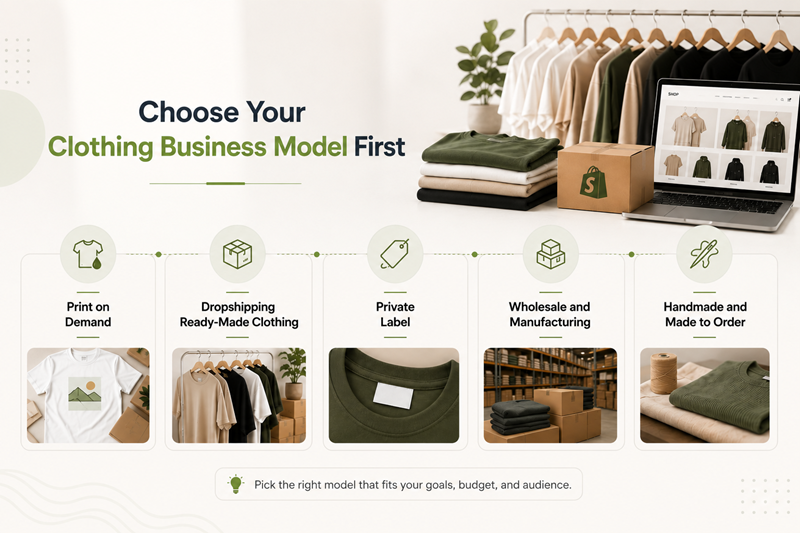
This is the biggest difference between starting a clothing brand and most other online stores. How you source and fulfill your products decides your startup cost, your profit margin, your risk, and how much of your day goes into operations. Pick the model before you build, because it affects your suppliers, your pricing, and even your product photography.
Print on demand
You create designs, place them on blank apparel like t-shirts, hoodies, and sweatshirts, and a provider prints and ships each item only after a customer orders. There is no inventory and almost no upfront cost. Popular providers such as Printful, Printify, and Apliiq connect directly to Shopify. This model is well suited to graphic and design-led brands, and the wider print on demand market reached around USD 13 billion in 2026 while growing more than 20% a year. The tradeoff is thinner margins and slower production times than holding stock.
Dropshipping ready-made clothing
Instead of printing your own designs, you sell a supplier’s existing clothing and they ship directly to your customer. Apps like Trendsi and Shopify Collective make it possible to list apparel from vetted suppliers without buying stock first. This is fast to launch and offers a wide selection, but many sellers offer the same products, so branding and marketing matter even more.
Private label
You take existing products, add your own branding, labels, and packaging, and sell them as your own line. This sits between dropshipping and full manufacturing. It builds a more recognizable brand while still avoiding heavy production work, and shopper trust in private label products has grown steadily in recent years.
Wholesale and manufacturing
You design your own pieces and produce them through a manufacturer, then sell direct to customers or wholesale to other retailers. This gives you the most control over quality, fit, and materials, and the strongest margins at scale. It also needs the most upfront investment, planning, and inventory management, so it usually suits founders who have validated demand first.
Handmade and made to order
You design and produce pieces yourself, or in a very small team, and sell directly through your store. This works well for slow fashion, custom tailoring, and craft-led brands. It protects quality and story, but it is harder to scale because your time is the limit.
A practical way to start is to validate demand with a lower-risk model like print on demand or dropshipping, learn what your customers actually buy, then move into private label or your own manufacturing once you know what sells. One rule holds across every model: order samples before you commit to a supplier. You cannot judge fabric, fit, or print quality from a photo, and quality is what protects your reviews and your reputation.
Why Shopify Is the Smartest Choice for an Online Clothing Store
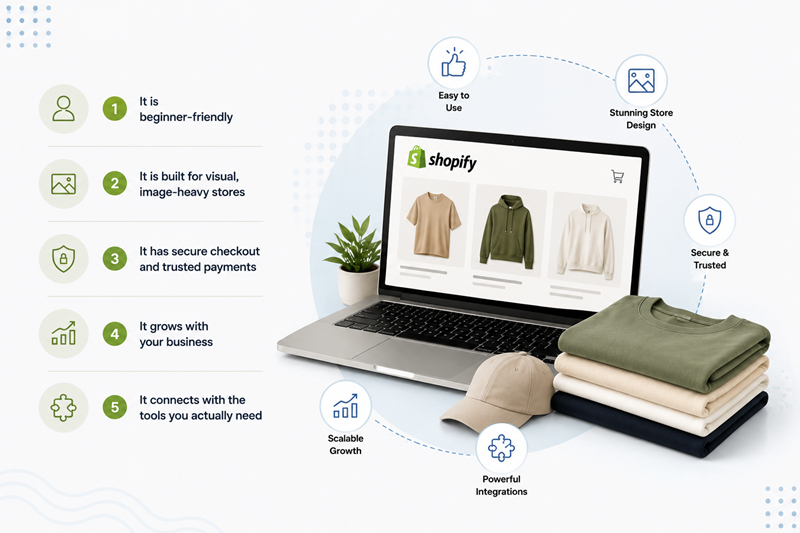
There are plenty of eCommerce platforms out there, including WooCommerce, BigCommerce, Squarespace, and Wix. So why does Shopify keep coming out on top for clothing brands specifically?
1. It is beginner friendly
If this is your first online business, Shopify keeps the setup manageable. You can add products, build collections, set prices, manage orders, and connect payments from a single dashboard. That matters, because most new clothing founders are already handling design, sourcing, photography, packaging, customer service, and social media at the same time. You do not need a complicated backend slowing you down.
2. It is built for visual, image-heavy stores
Clothing sells on how it looks and how customers imagine it on themselves. Your store needs large images, clean layouts, lifestyle shots, model photos, and smooth mobile browsing. Shopify themes are designed for exactly this, with product galleries, collection filters, quick views, and organized layouts that let your apparel take center stage without building everything from scratch.
3. It has secure checkout and trusted payments
Shoppers want to know their payment details are safe and their order will arrive as promised. Shopify offers a secure checkout and supports many payment options, and the platform is Level 1 PCI DSS compliant, which helps protect payment data. For clothing stores that rely on repeat buyers and word of mouth, that trust is worth a lot.
4. It grows with your business
You might launch with 20 products and later expand into hundreds of styles, multiple collections, wholesale, and international selling. Shopify supports that growth. A new clothing brand can start on a standard plan, while larger brands can move to Shopify Plus when they need enterprise features, advanced checkout customization, and higher-volume support. For most new clothing businesses, a standard plan is more than enough. Shopify Plus is usually better for brands generating over a million dollars in annual revenue.
5. It connects with the tools you actually need
Shopify plugs into apps for email and SMS marketing, reviews, loyalty, size guides, product options, upsells, shipping, returns, and every major print on demand and dropshipping provider. Selling clothing online does not end when your store goes live. You need traffic, trust, repeat buyers, and a way to handle returns, and Shopify’s app ecosystem covers all of it.
Your Complete Shopify Clothing Store Setup Guide
Now let’s get into the actual process. Here is your Shopify clothing store setup, step by step.
Step 1: Define Your Clothing Niche and Target Audience
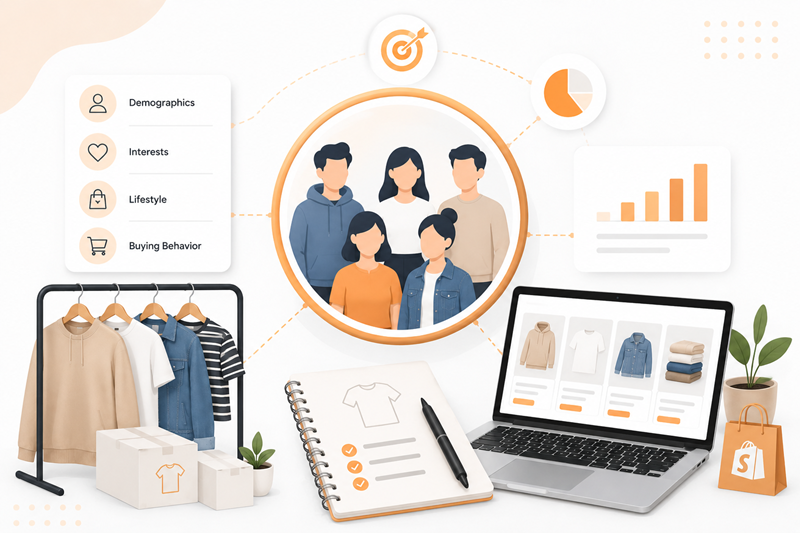
Your niche is the specific corner of the clothing market you want to own. Do not choose it only because it is trending. Choose it because there is real customer demand, room for your brand, and a product angle you can support consistently. For example:
- Instead of t-shirts, choose heavyweight organic cotton tees for minimalists.
- Instead of activewear, choose squat-proof leggings with inclusive sizing.
- Instead of kids clothing, choose gender-neutral basics for toddlers.
Once your niche is set, write a simple customer profile. Ask who this person is, why they buy clothing, what price feels comfortable, whether they buy for themselves or others, what fit concerns they have, and what would make them trust a new brand. This one exercise will improve your product descriptions, your images, your collections, and your marketing.
Step 2: Research Competitors and Market Trends
Competitor research is not about copying other clothing stores. It is about understanding what customers already respond to, and where you can do better.
Study bestselling styles, pricing ranges, website design, photography, customer reviews, return policies, shipping offers, and social content across your competitors. Read their reviews closely, because reviews reveal what shoppers love and what frustrates them. In clothing, the complaints are predictable: sizing that runs off, colors that look different in person, slow shipping, cheap fabric, and photos that do not match the product. Every one of those is an opening for your store to build trust.
For trend and demand research, a few useful places:
- Pinterest for visual trends and style boards
- Google Trends to see search interest over time
- Instagram and TikTok, where new clothing styles break first
- Etsy for handmade and independent fashion
- Amazon best-seller lists and reviews in your category
You are looking for gaps where demand exists but nobody has fully served it, while also learning from what already works.
Step 3: Create a Strong Brand Identity
Clothing brands live or die on feeling. Your identity should tell customers what your style is within seconds. A minimalist basics label should not look like a loud streetwear drop, and a premium tailoring brand should not feel like a discount marketplace.
Build your identity around your brand name, logo, color palette, typography, photography style, packaging, product naming, tone of voice, and the story behind why you started. That story does not need drama. Maybe you could never find quality basics that actually fit. Maybe your designs come from a place, a culture, or a subculture you belong to. Maybe you care about making clothing that lasts instead of clothing that gets thrown away in a season. The goal is simple: give customers a reason to remember you and come back.
Step 4: Decide on a Name and Buy a Domain
Your clothing brand name should be simple, memorable, and easy to spell. Avoid names that are too long, too trendy, or too close to an existing label.
Before you commit, check domain availability, social media handle availability, trademark conflicts, search results for similar names, and whether the name still works if you expand your product line later. Once you settle on a name, buy a custom domain. A yourbrand.com address looks far more trustworthy than yourbrand.myshopify.com, and a .com is worth the small cost if it is available.
Step 5: Set Up Your Shopify Store
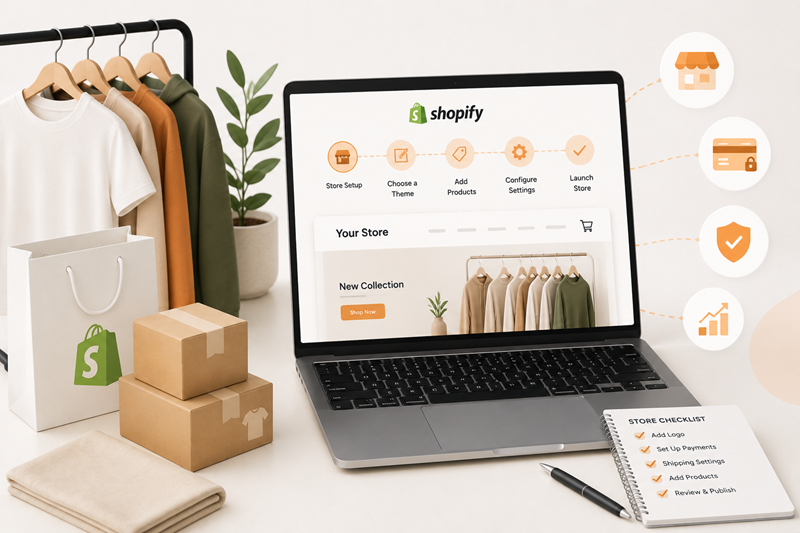
This is where the build begins. Create your Shopify account, add your business details, and choose a plan that fits where you are today. For most new clothing brands, a standard Shopify plan is the right starting point. You get everything needed to build, launch, and run the store without paying enterprise-level costs.
Your core setup should cover:
- Store name and business address
- Currency and time zone
- Tax settings and shipping zones
- Payment methods and checkout settings
- Customer accounts
- Store policies
- Domain connection and email notifications
Then create your key pages: Home, Shop, Collections, About, Contact, FAQ, Shipping Policy, Return and Exchange Policy, Privacy Policy, Terms of Service, and a Size Guide. For clothing, the size guide is not optional. Clear sizing reduces confusion, cuts returns, and builds confidence before a customer ever adds to cart.
Step 6: Choose Between a Free Theme and a Paid Theme
Your theme controls how your store looks and works. For clothing, the best theme is clean, fast, image-friendly, and easy to shop on a phone. Shopify offers both free and paid options.
A free theme is a smart choice on a small budget. Shopify’s Dawn theme is a strong example, with a minimal design that lets product images stand out. Paid themes usually add more design flexibility, advanced filtering, lookbooks, promotional sections, quick view, and stronger collection layouts.
When choosing from the best Shopify themes for clothing stores, do not judge on looks alone. Check the mobile experience, image gallery, collection filters, page speed, customization options, review rating, and cart flow. A theme that looks beautiful but loads slowly or hides products behind clumsy navigation will quietly cost you sales.
If you want a store that feels genuinely custom, with product pages and collection layouts built around your exact catalog, it can help to hire a Shopify designer rather than forcing a template to do something it was not built for. Custom design pays off most for brands with a strong visual identity or an unusual product range.
Step 7: Add and Optimize Your Clothing Products
Your product pages are where browsing turns into buying. Clothing shoppers want to see the piece clearly, understand the fabric, judge the fit, and imagine it on themselves before they trust you with their money.
Each product page should include:
- Product name and clear price
- Multiple high-quality images
- Model or on-body shots
- Close-up detail shots of fabric and stitching
- Fabric and material information
- A size guide and fit notes
- Color options shown accurately
- Care instructions
- Shipping timeline
- Return and exchange summary
- Customer reviews and photos
- Styling suggestions
Product photography tips
Use several images per product: a front view, a back view, a close-up of the fabric, an on-model shot, and a lifestyle or styling image. For clothing, the on-model shot does heavy lifting, because it shows fit, drape, and length in a way a flat product photo cannot. If you sell inclusive sizing, showing the same piece on different body types builds real trust.
Product description tips
Skip generic lines like “beautiful top for women, perfect for any occasion.” Instead, answer the questions a shopper is actually asking. For example: “Cut from midweight 100% organic cotton, this relaxed tee has a slightly boxy fit that sits just below the waist. It runs true to size, holds its shape after washing, and layers easily under a jacket for cooler days.” That tells the customer what it is, how it fits, how it wears, and why it belongs in their cart.
Step 8: Set Up Secure Payments, Shipping, and Returns
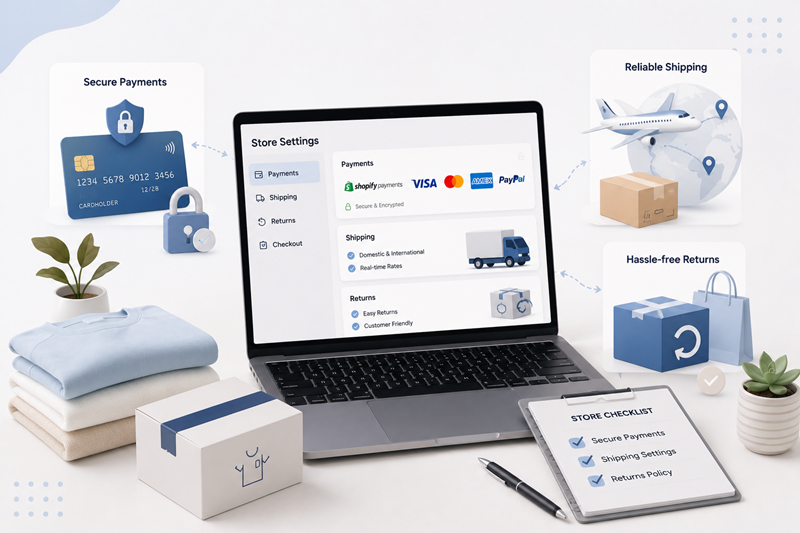
Payments, shipping, and returns decide whether a shopper feels safe buying from a brand they have never heard of.
For payments, offer the methods your audience already trusts, which usually means credit and debit cards, Shop Pay, PayPal, Apple Pay, Google Pay, and a buy now, pay later option if it fits your price point. Keep checkout short. Clothing is often an impulse buy, and every extra step at checkout invites second thoughts.
For shipping, make your policy clear and visible: processing time, shipping methods, delivery estimates, domestic and international costs, any free shipping threshold, tracking, and duties for international orders.
Returns deserve special attention in clothing, more than almost any other category. Fit and fabric are impossible to judge perfectly online, so returns will happen. A clear, fair, and easy return and exchange policy actually increases sales, because it removes the fear of getting stuck with something that does not fit. Spell out your window, your process, and your conditions, and make exchanges as painless as you can.
Step 9: Add Essential Shopify Tools and Apps
Shopify works well on its own, but the right apps improve marketing, trust, and operations. The trap is installing too many at once, which slows your store, creates conflicts, and drives up your monthly costs. Start with the essentials:
- Product reviews with photos
- Email and SMS marketing
- Size guides and fit tools
- Product options and variants
- Wishlist
- Loyalty and rewards
- Upsells and cross-sells
- Your print on demand or dropshipping provider
- Shipping and tracking
- Returns and exchange management
- Live chat
- Analytics
A brand selling custom apparel needs strong product options. A brand with a wide size range needs a proper size guide app. Choose apps around your actual business needs, not because they are popular.
Step 10: Optimize for SEO and Mobile Users
If you want shoppers to find your store through search instead of paying for every visit, Shopify SEO needs to be part of your setup from the start, not an afterthought once the store is live.
Shopify lets you edit SEO titles and meta descriptions for products, collections, pages, and blog posts. Use that to make each page clearer for both search engines and shoppers. A basic search checklist for clothing stores:
- Homepage title and meta description
- Collection page titles and descriptions
- Product page titles and descriptions
- Image alt text
- Clean URL handles
- Internal links between related products and collections
- Blog content around real customer questions
- FAQ and schema where possible
- Page speed and mobile layout
Use keywords naturally and avoid stuffing the same phrase into every sentence. Instead of repeating “buy clothes online” everywhere, build genuinely helpful content around what your customers search for, like styling guides, fabric explainers, and fit advice. For a deeper walkthrough of on-page and technical optimization, our Shopify SEO checklist for 2026 breaks it down step by step.
Mobile deserves its own focus. Most clothing shoppers will find you through Instagram, TikTok, Pinterest, or a Google search on their phone, and roughly 80% of fashion store visits already happen on mobile. Check that your images load quickly, your Add to Cart button is easy to reach, your menu is simple, your filters work, and your checkout is smooth. A gorgeous desktop site does very little if the mobile experience feels clumsy.
Step 11: Launch and Market Your Clothing Business
Before you launch, test the store like a customer. Place a test order. Click every menu item. Read every policy. Check your product pages on a phone. Confirm your shipping rates and payment settings. Ask a few honest people to browse and tell you where they got confused.
When everything holds up, launch with a plan. Do not expect a single launch post to carry the business. Marketing is ongoing work. Your first launch simply gives you your first wave of traffic, sales data, and customer feedback, which you then use to improve. Lean on the channels where your audience already spends time, whether that is short-form video, influencer partnerships, email, or paid social once the store is converting.
Step 12: Track, Analyze, and Scale
Once your store is live, watch the numbers that actually tell you what is working:
- Website traffic
- Conversion rate
- Average order value
- Add-to-cart rate
- Cart abandonment rate
- Bestselling products
- Return rate by product
- Email signup rate
- Customer acquisition cost
- Repeat purchase rate
These numbers point you toward your next move. If traffic is high but sales are low, your product pages, pricing, or sizing information may need work. If people add to cart but do not buy, check shipping costs and checkout friction. If one style sells out, build variations or bundles around it. If a product has a high return rate, your sizing or photography is probably promising something the item does not deliver.
Scaling does not always mean adding more products. Often it means improving your best sellers, raising average order value, collecting more reviews, and making your store easier and safer to shop.
How Expert Village Media Helps Clothing and Fashion Brands Grow
Expert Village Media works with fashion and apparel brands on Shopify to turn browsing into buying. That means designing product pages and collection layouts built for how people actually shop for clothing, improving mobile speed and experience, setting up size guides and reviews that reduce returns, and building search visibility so brands stop paying for every single visit. For clothing stores in particular, small improvements to fit information, photography, and page speed often move conversion more than any single marketing campaign.
Common Mistakes to Avoid When Starting a Clothing Store on Shopify
Even great clothing can struggle when the store around it is poorly planned. Avoid these common mistakes:
- Choosing a niche that is far too broad
- Skipping a clear size guide and fit information
- Using low-quality or misleading product photos
- Writing thin descriptions that ignore fabric and fit
- Hiding or complicating your return policy
- Ignoring the mobile experience
- Installing too many apps at launch
- Ordering no supplier samples before selling
- Copying bigger brands too closely
- Expecting instant sales after launch
Get Shopify Expert Help to Build and Grow Your Clothing Store
You can do a basic Shopify clothing store setup on your own, but when you hire a Shopify expert, the process becomes faster, smoother, and more professional. An expert can help you choose the right theme, design product pages that sell, organize collections, add the tools that reduce returns, improve mobile performance, and lay a proper SEO foundation. That matters even more for clothing, where customers depend on clear images, fit details, size guides, reviews, and a trustworthy checkout before they buy.
If you sell custom apparel, run a large catalog, or want a store that reflects a strong brand identity, professional help can make the whole thing easier to manage and easier for customers to shop.
Book a free consultation with our team, and you can skip the common setup mistakes and launch a store that looks polished, works smoothly, and is built to grow.
Frequently Asked Questions
1. How much does it cost to start an online clothing business with Shopify?
It depends heavily on your business model. With print on demand or dropshipping, you can start for very little beyond your Shopify plan, since there is no inventory to buy upfront. A realistic beginner setup, including a standard plan, a few essential apps, and a domain, often runs between USD 40 and USD 100 a month. Manufacturing your own line costs far more because of fabric, production, and inventory. A common approach is to start lean with a low-risk model, then reinvest profits into custom production once you know what sells.
2. What are the best Shopify themes for clothing stores?
The best themes for clothing are clean, fast, image-focused, and easy to browse on mobile. Free themes like Dawn work well for beginners, while paid themes usually offer more advanced filters, lookbooks, promotional sections, and premium layouts. Always check the mobile experience, image gallery, and page speed before committing, because those affect sales more than design alone.
3. Which Shopify plan is best for a clothing store?
For most new clothing brands, the Basic plan is a solid starting point. It includes the core features needed to build a store, add unlimited products, manage inventory, accept payments, and sell across channels. As your brand grows, the Grow or Advanced plan brings lower card rates, more staff accounts, and stronger reporting. Shopify Plus is usually unnecessary early on and better suited to high-volume brands with complex operations.
|
Shopify Plan |
Monthly Price |
Best For Clothing Stores That Need |
| Basic | USD 39/month | A simple starting plan for new clothing brands, solo founders, and small catalogs |
| Grow | USD 105/month | More staff access, better shipping discounts, and lower transaction costs as sales grow |
| Advanced | USD 399/month | Stronger reporting, lower payment rates, and more support for scaling apparel brands |
| Plus | From USD 2,300/month | Enterprise features, custom checkout, wholesale and B2B selling, and high-volume operations |
4. Do I need Shopify Plus for a clothing store?
Most new clothing brands do not need Shopify Plus. A standard plan is usually enough to launch and grow. Shopify Plus makes sense for high-volume brands, large teams, advanced checkout needs, international expansion, or complex wholesale and B2B operations.
5. Is print on demand or dropshipping better for a clothing business?
Both let you start without holding inventory, but they suit different goals. Print on demand is best if you want to sell your own original designs on blank apparel, with no inventory risk and slightly slower production. Ready-made dropshipping is faster to launch with a wider selection, but you often sell the same products as other stores, so branding and marketing carry more weight. Many strong brands begin with one, validate demand, then move toward private label or their own production.

Amit Porwal
CEO and FounderAmit Porwal is the CEO and Founder of Expert Village Media and Wiser AI . He’s passionate about e-commerce, and loves helping Shopify store owners boost sales with upselling, cross-selling, digital marketing, & personalized shopping experiences. With years of experience in e-commerce web development Amit believes in building simple and effective online store that actually make a difference. He is always excited to talk about the power of personalization and how he can make e-commerce smarter and more customer-friendly with the help of AI.
 US Office
 INDIA Office
 UK Office