

Selling on ChatGPT: How Shopify Agentic Storefronts Work and How to Get Your Products Recommended by AI
Contents
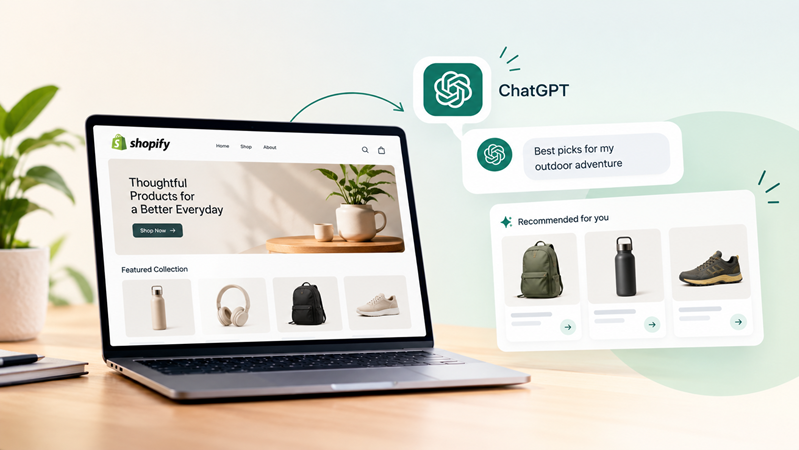
A growing number of shoppers are skipping the search bar entirely. Instead of typing “best running shoes under $100” into Google, they ask ChatGPT the same question in plain English and get back a short list of products instead of ten blue links.
This shift has a name: agentic commerce. You’ll also see it called AI shopping or AI ecommerce, all pointing at roughly the same idea. Shopify has built a system around it called Agentic Storefronts, already live for a large share of Shopify merchants selling to US customers. If you run an ecommerce store, you’ve probably heard a lot of hype about this. Some of it is fair. Some isn’t.
This guide covers what selling on ChatGPT actually means, how Shopify’s agentic storefronts work, what influences whether AI recommends your product, and what’s still genuinely uncertain, based on what Shopify and OpenAI have published as of late 2026.
What Is Agentic Commerce, Exactly?
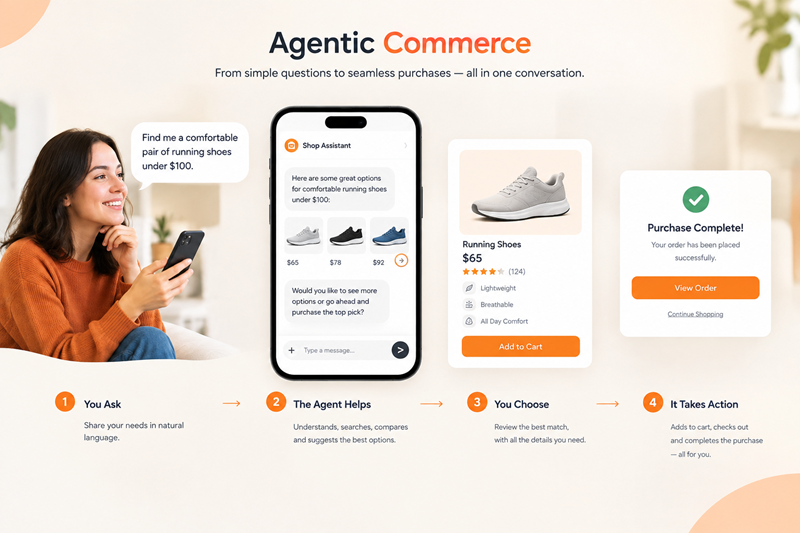
Agentic commerce describes AI assistants like ChatGPT, Microsoft Copilot, and Google’s Gemini helping people find, compare, and buy products inside a conversation, instead of sending them to a search results page or an app. An AI agent does some of the shopping work on the person’s behalf: pulling in options, checking prices and availability, and sometimes handling part of the purchase.
It’s an evolution of two things that already existed. Chatbots have answered shopping questions for years. Recommendation engines have compared products for years. Agentic commerce combines both, plus a transaction layer, into one conversation.
Worth being precise here: this isn’t the same as a Google Shopping ad, and it isn’t the same as ranking on page one of Google. It’s a separate discovery channel with its own mechanics, which matters for the rest of this guide.
How AI Shopping Actually Works, From Question to Purchase
Here’s roughly what happens when someone asks an AI assistant for a recommendation, based on how Shopify and OpenAI describe the process:
- The shopper describes what they want in plain language, like “a birthday gift for a 10-year-old who’s into art.”
- The AI agent searches the product data it has access to, whether that’s a structured feed, Shopify’s catalog infrastructure, or public web content.
- It narrows things down and presents a short list, usually with images, prices, and brief descriptions.
- The shopper refines by budget or preference, and the agent adjusts.
- When ready to buy, what happens next depends on the platform. Some allow checkout inside the conversation. On ChatGPT specifically, the shopper is currently handed off to the merchant’s own website through an in-app browser.
That last step matters more than most coverage of this topic lets on, and we’ll come back to it.
What Shopify Agentic Storefronts Actually Do

Shopify Agentic Storefronts is a sales channel in the Shopify admin that connects a merchant’s catalog to AI platforms including ChatGPT, Microsoft Copilot, and AI Mode in Google Search. Shopify says it needs no apps and no custom integration for most merchants, since it runs on a data layer called Shopify Catalog.
Shopify Catalog does the heavy lifting. It takes a merchant’s existing product information (titles, descriptions, images, pricing, inventory, shipping) and standardizes it into a format AI systems can read consistently. Shopify states eligible products are included automatically, and admin updates like a price change or a sold-out variant flow through to connected AI platforms without extra work.
A few practical points:
- Eligibility varies by channel.Merchants in Shopify Catalog selling to US buyers can generally appear in ChatGPT and Microsoft Copilot. AI Mode in Google Search and the Gemini app are currently limited to a smaller set of US-based stores, with broader access said to be rolling out over time.
- Checkout behavior differs by platform.Microsoft Copilot and Google’s AI surfaces support direct in-agent checkout merchants can toggle on or off. For ChatGPT, checkout currently happens on the merchant’s own site.
- You don’t need Shopify to participate.A separate Agentic Plan lets businesses on other platforms list products in Shopify Catalog and reach the same AI channels without switching stores. It’s rolling out gradually with a waitlist as of publication.
- You stay the merchant of record.Across every channel, the store owns the customer relationship, order data, and fulfillment, even when discovery happened elsewhere.
Businesses far outside ecommerce are watching this shift closely. Across customer service, logistics, and internal operations, companies are investing in AI agent development to prepare for software agents completing more of a transaction. Retail is simply one of the more visible early test cases.
Early coverage of ChatGPT shopping from late 2025 centered on Instant Checkout. OpenAI launched it that September alongside Stripe, using an open standard the two co-developed called the Agentic Commerce Protocol (ACP). The idea: a shopper completes a purchase from a participating Etsy or Shopify seller without leaving the chat.
By early 2026, OpenAI had expanded Instant Checkout further. Then in March 2026, OpenAI scaled it back, saying the initial version didn’t offer the flexibility it wanted and that it was shifting focus toward helping shoppers find and compare products rather than completing transactions itself. Merchants now handle checkout on their own site once a shopper clicks through.
This is a useful reminder that agentic commerce is still a young, moving target. Right now, ChatGPT works mainly as a product discovery channel: a well-informed sales associate pointing a customer toward your store, not a cashier ringing them up in-house. ACP itself hasn’t gone away; it’s open source and still used for discovery and product data, and OpenAI has hinted further checkout changes could come later, though nothing is confirmed.
A separate, broader standard called the Universal Commerce Protocol (UCP), from Google, Shopify, and a coalition including Etsy, Target, Walmart, Mastercard, and Visa, aims for native in-agent checkout across multiple AI platforms. UCP already powers direct checkout inside Microsoft Copilot and Google’s AI shopping surfaces for eligible Shopify merchants. Whether ChatGPT adopts something similar isn’t something anyone outside OpenAI can say with confidence.
Product Feeds and Structured Data: Teaching AI About Your Products
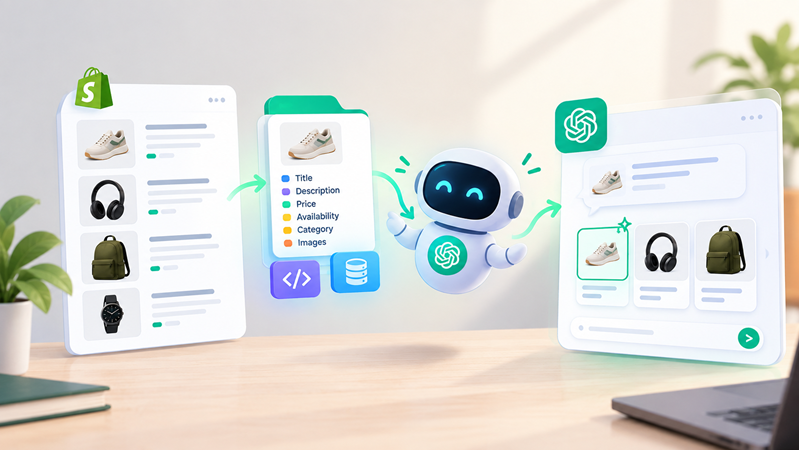
AI agents don’t browse a store page like a person scrolling through photos. They read structured information: title, description, price, currency, availability, images, and a link back to the product page. How complete and accurate that data is determines whether a product gets considered at all, before quality even enters the picture.
On Shopify, this is mostly handled for you. Shopify Catalog pulls the relevant fields from your product pages automatically, and Shopify offers a free tool that scans a product URL and reports on missing structured data.
If you’re not on Shopify, OpenAI publishes its own product feed specification for merchants who want their catalog discoverable in ChatGPT directly. At minimum, that typically means a stable product ID, title, plain-text description, page link, primary image, price with currency, and current availability, plus optional fields like variants and shipping details that help match more specific questions.
The practical takeaway: vague titles, thin descriptions, missing alt text, or stale inventory data likely limit how AI systems can represent your products, regardless of platform.
What Actually Influences Whether AI Recommends Your Product
There’s no public ranking algorithm to reverse engineer here the way there sort of is with Google, and both Shopify and OpenAI have said ranking factors vary by platform and aren’t fully disclosed. Based on what’s been published, a few factors show up consistently:
- Data completeness.Rich attributes make it easier to match a product to a detailed question (“waterproof,” “fits under six feet”). Thin listings are harder to match confidently.
- Real-time pricing and inventory accuracy.Outdated pricing or stock erodes trust in a recommendation.
- Structured formatting and categorization.Properly tagged products are easier for AI to place in the right context.
- Engagement signals.Some platforms factor in how often a recommended product gets clicked or purchased.
- Trust and review signals.Genuine reviews and clear policies appear to factor in, though exact weighting isn’t public.
None of this guarantees a recommendation. The same question can return different answers depending on platform, conversation history, and phrasing. Treat this as a way to remove obstacles, not a formula with a guaranteed result.
AI Search Optimization vs Traditional SEO
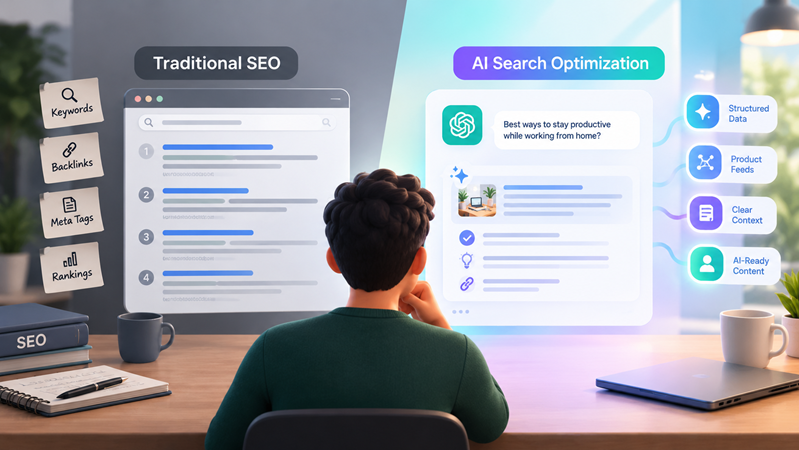
It’s tempting to treat AI search optimization as SEO applied to a different search box. That framing causes real confusion.
Traditional SEO tracks a stable, publicly visible concept: a ranked list of results for a query. AI product recommendations don’t work that way. There’s no single position one to chase, no rank tracker, and the same question asked twice can surface different products depending on context and ongoing model changes.
That doesn’t mean the two are unrelated. Well-organized, accurate, easy-to-parse content helps both. The mistake is assuming a Google ranking guarantees a ChatGPT recommendation, or that optimizing a feed for AI moves your Google rankings. They share foundations; they aren’t the same job.
Product Content Best Practices for AI Discoverability
A few habits worth prioritizing, drawn from Shopify’s and OpenAI’s own guidance:
- Write titles with specific, searchable details (material, size, use case), not just brand and SKU.
- Use full, plain-language descriptions rather than short taglines.
- Keep pricing and stock status current; update promptly when something sells out.
- Fill in structured attributes (color, size, material, weight) instead of leaving them blank.
- Use quality primary images with descriptive alt text.
- Publish clear return, shipping, and business policy information.
Here’s a hypothetical example. Say a skincare brand sells a fragrance-free moisturizer, but the product page just says “Daily Moisturizer” with a two-sentence description and no skin type or ingredients listed. A shopper asking an AI assistant for “a fragrance-free moisturizer for sensitive skin” may never see it, simply because those terms aren’t in the data. Adding “fragrance-free,” “sensitive skin,” and key ingredients wouldn’t guarantee a recommendation, but it would meaningfully improve the odds the product is even considered.
Trust Signals, Reviews, and Real-Time Accuracy
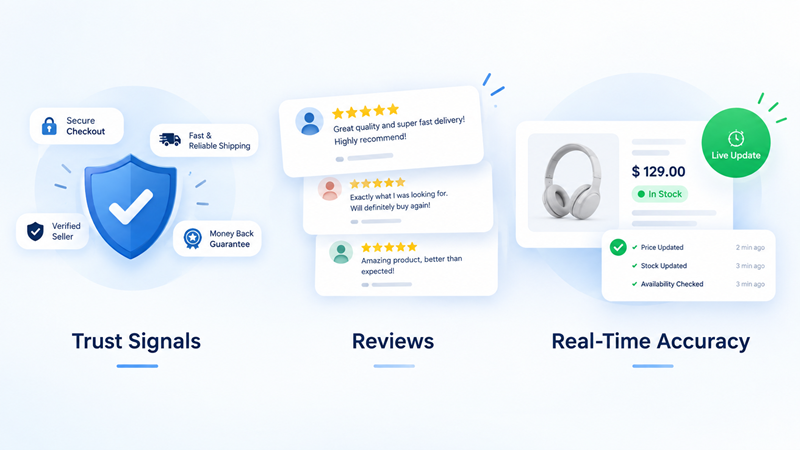
Shopify has said that when AI platforms rely on scraped web data instead of a direct feed, they’re more likely to surface outdated pricing or stock, which damages buyer trust and, indirectly, a merchant’s odds of a repeat recommendation. That’s part of the reasoning behind giving merchants a verified data connection through Shopify Catalog.
For merchants, the practical version is simple: genuine, specific reviews carry more weight than a high star rating with few reviews behind it, and clear shipping and return policies matter both because shoppers ask about them directly and because they signal legitimacy. Keeping pricing and availability synced as close to real time as your platform allows is one of the more concretely useful things you can do this year.
Technical Basics: Crawler Access and Protocols
Plenty of merchants unintentionally block themselves out of AI shopping results through robots.txt, often without realizing it. OpenAI runs a few automated systems with different jobs: GPTBot collects content for model training, OAI-SearchBot indexes content for ChatGPT’s search and shopping features, and ChatGPT-User fetches a page in real time when asked to visit it. Each can be allowed or disallowed independently. Blocking GPTBot doesn’t affect shopping visibility; blocking OAI-SearchBot or ChatGPT-User generally will.
Check your site’s robots.txt file directly (yourdomain.com/robots.txt) to confirm nothing was accidentally disallowed, especially if a security plugin added broad AI-blocking rules recently.
On protocols, a rough map helps without needing an engineering degree. ACP, from OpenAI and Stripe, currently governs how ChatGPT accesses product data and connects to checkout where applicable. UCP, from Google and Shopify with a wide coalition, aims to be a broader standard covering in-agent checkout across platforms. On Shopify, you generally don’t implement either protocol yourself; the platform handles that translation behind the scenes.
Common Mistakes to Avoid
- Assuming Shopify’s default setup means there’s nothing left to do.The plumbing is automatic; the quality of what flows through it is still on you.
- Treating this as a guaranteed sales channel.Fast reported growth from a small base is still a small number for most individual stores today.
- Ignoring robots.txt.A blocked crawler silently removes a store from consideration, with no error message to flag it.
- Copying thin descriptions straight from a supplier feed.Generic manufacturer copy rarely has the specific details a shopper’s question needs.
- Confusing AI optimization with paid placement.There’s no confirmed way to pay for a better AI recommendation the way you can pay for a Google Shopping ad.
Measuring Performance and What to Do Next
Shopify says orders from AI channels appear in the merchant’s admin with attribution showing which platform drove the sale, a reasonable starting point for measurement. Beyond that, watch referral traffic from sources like chatgpt.com or copilot.microsoft.com in your regular analytics, and compare conversion rates against your other channels. Treat any numbers over the next year as directional, not definitive, since this is still early.
A reasonable order of operations:
- Confirm Agentic Storefronts is active in Shopify admin, under Settings, then Sales Channels.
- Check robots.txt for accidental blocks on OAI-SearchBot and ChatGPT-User.
- Run key product pages through Shopify’s free agentic readiness audit tool, or review OpenAI’s feed requirements if you’re not on Shopify.
- Fix structured attributes and rewrite thin descriptions for best sellers first, not the whole catalog.
- Make sure reviews, return policy, and shipping information are easy to find and current.
- Revisit quarterly. Eligibility rules and platform behavior have already changed several times this past year.
FAQs
Is selling on ChatGPT the same as buying a Google Shopping ad?
No. There’s no confirmed paid placement system for AI shopping recommendations. Discovery currently runs on data quality and, on some platforms, engagement signals, not ad spend.
Do I need a separate app to get my Shopify store on ChatGPT?
For most eligible Shopify merchants selling to US buyers, no. Agentic Storefronts activates automatically through Shopify Catalog.
Can shoppers actually complete a purchase inside ChatGPT?
Not through the merchant’s own checkout, as of this writing. ChatGPT routes shoppers to the merchant’s website via an in-app browser, following OpenAI’s move away from Instant Checkout in March 2026.
How do I sell products on ChatGPT if I don’t use Shopify?
Shopify’s Agentic Plan lets merchants on other platforms list products in Shopify Catalog, though it’s rolling out gradually. Larger merchants can also work directly with OpenAI’s published feed specification.
Will optimizing for AI shopping hurt my Google rankings?
No evidence of that. Clear, accurate, well-structured product content tends to support both, since each rewards complete information over thin or misleading content.
How long until I see results?
There’s no fixed timeline, and it’s too early for anyone to give a reliable number. Treat better product data as sound ecommerce practice with a reasonable chance of paying off here, not a guaranteed short-term traffic strategy.
The Bottom Line
Agentic commerce is still being built in public. Instant Checkout came and went inside six months, protocols are still being finalized, and Shopify’s own eligibility rules for channels like Google’s AI Mode are still expanding. Anyone claiming to have fully cracked how to get recommended by ChatGPT is overselling what’s currently knowable.
What is knowable: AI shopping assistants read structured product data, reward completeness and accuracy over cleverness, and the fundamentals that have always mattered in ecommerce (clear product information, honest reviews, accurate pricing, a trustworthy checkout) are the same ones that matter here. Get those right, keep your Shopify settings and robots.txt file in shape, and treat this as one more discovery channel to maintain rather than a system to game. That’s a reasonable, evidence-based place to start, and it should serve you well even as the specifics keep changing.

Amit Porwal
CEO and FounderAmit Porwal is the CEO and Founder of Expert Village Media and Wiser AI . He’s passionate about e-commerce, and loves helping Shopify store owners boost sales with upselling, cross-selling, digital marketing, & personalized shopping experiences. With years of experience in e-commerce web development Amit believes in building simple and effective online store that actually make a difference. He is always excited to talk about the power of personalization and how he can make e-commerce smarter and more customer-friendly with the help of AI.
 US Office
 INDIA Office
 UK Office
